
|
When do you start burning fat? You burn fat from the start of your workout. Nothing ‘switches’ after 30 minutes: intensity and duration only determine how large the fat percentage is.
Your body uses several energy sources simultaneously during exercise – including fat and carbohydrates. What changes with training duration and intensity is not the switching on or off of fat burning, but its share in the energy supply. During light to moderate training, a larger share of energy usually comes from fat. At high intensity, the body relies more heavily on carbohydrates because they provide energy faster.
The practical consequence: You don’t have to cross a magic time limit. For high fat burning during training, regularly performed, moderate sessions of about 30 to 60 minutes of main effort are sensible. If your goal is to reduce body fat, what matters most is your energy balance over days and weeks, your training consistency, and a load from which you can recover well.
Jump to: 30-minute myth · Energy supply · Intensity · Duration · Training plan · FAQ
No. The idea of a fixed 30-minute limit oversimplifies the processes in the body too much. Fat burning is not a switch that is flipped after a certain time.
In the first seconds of an effort, energy must be available particularly quickly. Therefore, stored ATP and creatine phosphate initially play a major role. Simultaneously, energy production from carbohydrates and fats increases. With increasing duration, aerobic energy supply becomes increasingly important. In this process, ATP is formed with the help of oxygen from carbohydrates and fatty acids.
The true core behind the myth is: During a longer, moderate effort, the relative share of fat burning can increase over time. However, this does not mean that no fat was used before. Likewise, a 30-minute session does not yet guarantee a loss of body fat.
In order for your muscles to move, they need ATP, the cell’s immediately usable energy carrier. Because ATP stores are small, the body constantly produces it anew during training. To do this, it uses several overlapping pathways:
This system provides a lot of energy in a very short time. It is particularly important for an explosive start, a jump, or a short sprint. However, stores are quickly limited.
At high intensity, the body can quickly break down carbohydrates without the direct involvement of oxygen. This provides energy rapidly but can only be sustained for a limited time. During hard rowing intervals or a final sprint, the share of this pathway increases significantly.
During longer efforts, energy production with oxygen increasingly dominates. For this, the body uses both carbohydrates and fat. Which mixture prevails depends, among other things, on intensity, duration, training status, nutrition, and individual physiology. A deeper insight is provided in the article Aerobic Training: Heart Rate Zones and Physiological Effects in Rowing.
It is important to note: These systems do not replace each other like relay runners. They work simultaneously, just with different shares.

Here we must distinguish between the fat percentage and the absolute amount of fat. At very low intensity, a large percentage of energy can come from fat. However, because the total energy turnover per minute is low, the absolute amount of fat does not have to be particularly high.
As intensity increases, the energy requirement per minute increases. In the light to moderate range, absolute fat oxidation therefore often increases as well. From an individually different intensity, it reaches its maximum – often referred to as “Fatmax.” If the effort becomes even harder, the energy supply shifts more toward carbohydrates.
Schematic representation – individual values vary.
Prevailing tendency: High fat percentage, but low energy turnover per minute
Practical classification: Good for recovery and additional movement
Prevailing tendency: Often the highest absolute fat oxidation
Practical classification: You can still speak in full sentences; about 3–5 out of 10 on the exertion scale
Prevailing tendency: Carbohydrate share increases significantly
Practical classification: Good for performance development, but harder to sustain for long
Prevailing tendency: Creatine phosphate and carbohydrates dominate
Practical classification: Suitable for short intervals, not as a long continuous method
In a study with 300 healthy women and men, the highest measured fat oxidation averaged 48.3 percent of maximum oxygen uptake or 61.5 percent of maximum heart rate. However, the values differed significantly between individuals. Therefore, “train exactly at heart rate X” is not a serious general recommendation. The talk test and your perceived exertion are often more robust for everyday use. If you want to control it more specifically, the article Zone 2 Training on the Rowing Machine will help you with the classification. How you roughly determine your baseline value is also explained in the article Calculating Maximum Heart Rate and Classifying the Anaerobic Zone.
Three scientific papers help to classify the most important statements:
Chávez-Guevara and colleagues summarized 64 publications in a systematic review in 2023. The meta-regression included data from a total of 7,474 people with obesity. The range of maximum fat oxidation depended, among other things, on age, body fat, fitness, ergometer, and examination method. Depending on the body fat percentage, Fatmax averaged approximately 57 to 66 percent of the individual peak heart rate. This supports a moderate training range but also shows why a blanket fat-burning heart rate does not fit everyone.
Venables, Achten, and Jeukendrup studied a total of 300 healthy individuals in 2005. Maximum fat oxidation averaged 48.3 percent of maximum oxygen uptake or 61.5 percent of maximum heart rate. However, it varied with gender, fitness, and activity level. For your training, this means: There is a sensible intensity corridor, but no identical fat-burning zone for everyone.
A meta-analysis by Steele and colleagues from 2021 evaluated 54 studies. In a long-term comparison of interval training and moderate continuous endurance training, the difference in the change in fat mass was trivial. This argues against the idea that a single intensity method is fundamentally superior. Rather, the decisive factor is which form of training you can perform regularly and with an appropriate total load.
For fat burning during a single session, a moderate main effort of 30 to 60 minutes is a practical range. Beginners can start with 20 to 30 minutes of main effort. In addition, there are about 5 to 10 minutes for warming up and about 5 minutes for light cool-down rowing.
A longer session can convert more total energy and fat than a short session at the same intensity. However, it does not follow that longer is always better. If technique falters, you recover poorly, or the session becomes so large that you rarely perform it, the theoretically higher fat burning brings you little benefit.
Short intensive sessions can also be valuable. While carbohydrate use dominates during hard intervals, the energy turnover per minute is high and endurance performance can improve. Those with little time can therefore combine moderate continuous sessions and HIIT on the rowing machine.
The best duration is therefore not the longest possible, but the longest duration that you can train with clean technique, regularly, and well-recovered.
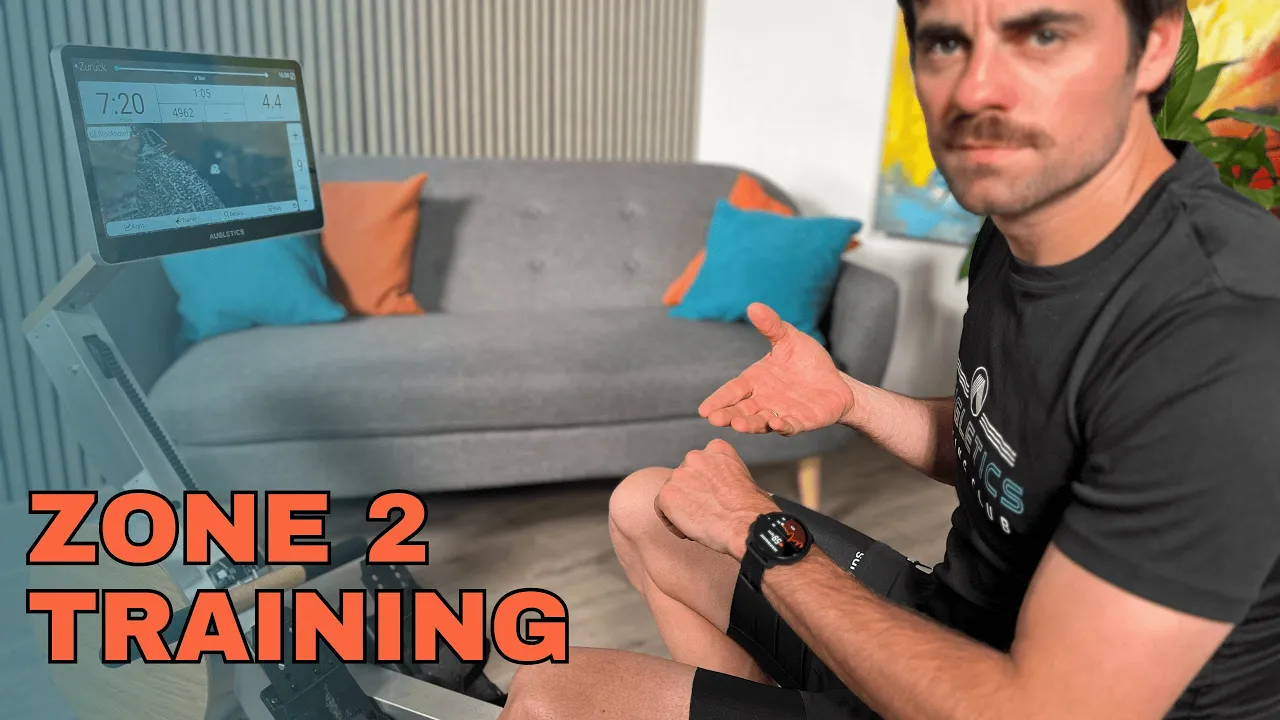
In the video, Lars shows how you control Zone 2 via heart rate, perceived exertion, and the talk test, and how this results in a practical rowing session.

Using fat as fuel during a session does not automatically mean that your fat mass will decrease in the long term. The body balances energy intake and energy consumption over many hours and days. Someone who uses a high fat percentage during light training but then consumes more energy than they use will not necessarily lose body fat.
For fat loss, several factors are therefore relevant together:
How rowing fits into this larger context is explained in the article Losing Weight Through Rowing: How the Rowing Machine Helps You Lose Fat. If you want to better classify your energy turnover, you will also find background information on Calorie Consumption During Rowing.
For many recreational athletes, a mix of two moderate sessions and one optional intensive session per week is a good starting point.
If you are just starting out, perform only the two moderate sessions for the first two to four weeks. Then extend the main effort by about 5 minutes before additionally introducing the interval session. There should be at least one light day between a hard session and the next intensive workout.

You intentionally train too lightly. A high percentage of fat sounds good, but at very low power, the total energy turnover remains low.
You train every session hard. High intensity is useful but increases carbohydrate requirements and the necessary recovery. Without a light foundation, consistency often suffers.
You chase an exact heart rate number. Formulas for maximum heart rate and blanket fat-burning zones can only provide rough guidance. Daily form, temperature, training status, and measurement errors change the heart rate.
You equate sweat with fat burning. Heavy sweating primarily shows the regulation of body temperature. It says little about how much fat you oxidize or lose in the long term.
You overestimate a single session. Body fat changes through the repeated balance of nutrition, everyday movement, training, and regeneration – not through a single workout.
Your body uses fat as part of its energy mix from the very beginning of the effort. Fat burning does not only start after 30 minutes. In the light to moderate range, absolute fat oxidation is highest for many people, while carbohydrates increasingly dominate during intensive efforts.
If you want to oxidize as much fat as possible during training, 30 to 60 minutes of moderate main effort is a sensible framework. If you want to lose body fat, the long-term energy balance also counts. Two regular foundation sessions and one optional interval session are usually more effective for this than searching for a magic minute or a perfect fat-burning heart rate.
Lars Wichert combines sports science knowledge with his experience as a former competitive rower, Olympic participant, three-time world champion, and coach. Three questions are particularly decisive for this article: Which energy systems work during an effort, how does intensity shift the fuel mix, and which form of training can be reliably implemented in the long term?
The scientific classification is based on the systematic review by Chávez-Guevara and colleagues on maximum fat oxidation, the large cross-sectional study by Venables, Achten, and Jeukendrup on individual Fatmax intensity, and the systematic review by Steele and colleagues on interval and moderate endurance training. The results describe average values and correlations; individual training zones may deviate from these.
Yes. Fat contributes to energy supply from the start, although not equally in every phase. In the first seconds and at high intensity, particularly quickly available energy systems and carbohydrates dominate. With longer moderate effort, the fat share can increase.
No. There is no fixed 30-minute threshold. Even shorter sessions use fat and increase energy consumption. Longer moderate sessions can oxidize more total fat because you maintain the effort for longer.
There is no universally best heart rate. Maximum fat oxidation is in the light to moderate range for many people but differs individually. Use the talk test as a practical guide: full sentences should still be possible. A performance diagnostic can determine the personal range more accurately.
During moderate continuous swimming, running, cycling, or rowing, a larger share of energy usually comes from fat than during HIIT. However, this does not automatically make moderate training superior in the long term. Meta-analyses show only small differences between interval and continuous endurance training for the loss of fat mass. Consistency and total volume are decisive. You can find more practical examples in the article HIIT on the Rowing Machine.
No. 20 minutes is a sensible start, especially for beginners, and better than a planned long session that doesn't happen. For a larger weekly training volume, you can gradually increase the duration or distribute several short sessions.


|

|

|
Take three minutes to find out if the AUGLETICS is also
the ideal sports equipment for you.
You are currently viewing a placeholder content from Vimeo. To access the actual content, click the button below. Please note that doing so will share data with third-party providers.
More InformationYou are currently viewing a placeholder content from YouTube. To access the actual content, click the button below. Please note that doing so will share data with third-party providers.
More InformationYou need to load content from reCAPTCHA to submit the form. Please note that doing so will share data with third-party providers.
More InformationYou are currently viewing a placeholder content from Facebook. To access the actual content, click the button below. Please note that doing so will share data with third-party providers.
More InformationYou are currently viewing a placeholder content from Klaviyo. To access the actual content, click the button below. Please note that doing so will share data with third-party providers.
More InformationYou are currently viewing a placeholder content from TrustIndex. To access the actual content, click the button below. Please note that doing so will share data with third-party providers.
More InformationYou are currently viewing a placeholder content from Typeform. To access the actual content, click the button below. Please note that doing so will share data with third-party providers.
More InformationYou are currently viewing a placeholder content from Google Maps. To access the actual content, click the button below. Please note that doing so will share data with third-party providers.
More Information